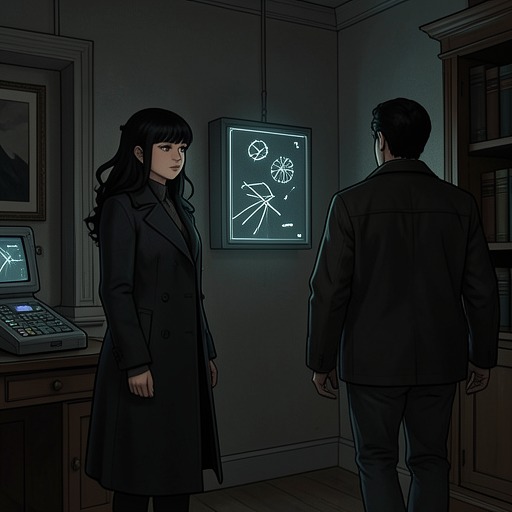
Maggie–Sarah Johanson roommate and collaborative relationship
The Stars Have EyesMaggie–Sarah Johanson roommate and collaborative relationship links Maggie, an unfathomable cosmic entity inhabiting a human form, with Sarah Johanson, a psionic agent whose military training and personal judgment repeatedly bring her into Maggie’s affairs. Their connection is neither a conventional friendship nor a simple partnership. It develops through proximity, supervision, experimentation, conflict, and mutual intervention, until Sarah becomes one of the few people able to challenge Maggie without reducing her to either a threat or an object of worship.
Shared Domestic and Operational Space
Maggie’s relationship with Sarah is grounded in shared access to the apartment and in the practical consequences of living near a being whose ordinary appearance conceals a vastly different nature. When Maggie and Joe return to the apartment with Joe’s family, Sarah has already heard the commotion and uses telepathy to request and obtain Maggie’s permission to leave without being noticed by Margaret Mulligan. The maneuver is deliberately covert and more elaborate than the situation strictly requires, but it shows Sarah’s familiarity with Maggie’s household and her awareness that domestic encounters with the cosmic entity can become socially explosive.
The apartment therefore functions as both home and operational environment. Sarah can withdraw from it, enter its arguments, monitor developments, and intervene when necessary. Maggie’s hospitality and authority over the space are clear, but Sarah is not portrayed as a passive guest. She possesses enough standing to act independently, while still recognizing that Maggie’s consent governs certain boundaries. Their room-sharing arrangement turns an extraordinary relationship into a routine of permissions, interruptions, and negotiated proximity.
Collaboration, Training, and Unequal Knowledge
The collaboration is shaped by a profound asymmetry of knowledge and power. Maggie can alter systems, improve technology, and reason through contractual or institutional problems with overwhelming speed. She offers to guard and nurture Joe while studying reality through him, and she confidently upgrades the Full Immersion Pod 3,000™. Her technical and cosmic abilities make ordinary human expertise appear limited, yet Sarah remains useful because she understands human institutions, military conduct, interpersonal consequences, and the practical limits of force.
Sarah’s position becomes especially important when Maggie’s fan club grows large enough to resemble a cult and threatens the terms of Maggie’s contract. Sarah overhears Joe and Maggie discussing Grant Maloney and bursts into the room to defend Grant, despite normally trying to avoid becoming entangled in the couple’s affairs. Her intervention is not detached procedure: her recent relationship with Grant has become serious enough that she reacts immediately when she believes he is being insulted. The outburst establishes Sarah as both an observer of Maggie’s domestic life and a participant with interests of her own.
Maggie’s response to Director Oliver Millington’s attempted manipulation further clarifies their working dynamic. Sarah argues angrily that Millington should be punished for trying to trick Maggie, while Maggie rejects disintegration as excessive. She distinguishes between violating clause 13-B and deserving physical destruction, choosing the restitution specified by the agreement instead. Sarah’s instinct is confrontational and protective; Maggie’s is formal, contractual, and calibrated. Their disagreement does not dissolve the partnership. Instead, it allows each woman’s expertise to correct the other’s: Sarah supplies moral urgency, while Maggie supplies restraint and procedural precision.
Conflict, Recognition, and Mutual Correction
The relationship repeatedly tests whether Maggie’s extraordinary capacities can coexist with human standards of responsibility. Sarah does not simply admire Maggie’s intelligence or fear her power. She challenges the consequences of Maggie’s decisions, objects when people close to her are threatened, and forces her to account for obligations that Maggie might otherwise treat as abstract clauses or experimental variables.
Maggie explicitly acknowledges this contribution. She thanks Sarah for the insight that prevented her from mistakenly believing she had violated her obligations. The statement gives Sarah a role beyond roommate, guard, or test subject: her interpretation has materially altered Maggie’s understanding of a contractual situation. Maggie’s gratitude is restrained and analytical, but it confirms that Sarah’s human perspective has become an operative part of Maggie’s decision-making.
At the same time, the relationship remains ethically uneven. Maggie describes Sarah as an excellent test subject when reflecting on their interactions and training sessions. That language is revealing because it preserves the cosmic entity’s tendency to classify people according to their usefulness for observation. Sarah’s willingness to train with Maggie does not erase that imbalance; rather, it shows how collaboration can coexist with objectification. Sarah accepts Maggie’s strange methods without surrendering her own judgment, and the tension between those positions gives the relationship much of its force.
Farewell and Emotional Change
The relationship reaches its clearest emotional expression when Maggie prepares to leave. She addresses Sarah formally as Psionic Agent 2nd Grade Sarah Johanson and says that she will miss her presence. Maggie recalls watching Sarah progress and develop through their interactions and training sessions, while Sarah initially tries to preserve a tough exterior. She then abandons that posture and hugs Maggie, admitting that she will miss having Maggie around despite the absurdity of the relationship.
The hug surprises Maggie, but she returns it. That reciprocal gesture matters because Maggie’s emotional responses are often filtered through calculation, observation, or literal interpretation. Here, she does not merely analyze Sarah’s sentiment; she accepts the physical expression of it. Her reply that the sentiment is unnecessary but appreciated retains her characteristic precision while also recognizing the feeling behind it.
Maggie’s final duty is to entrust Sarah with another responsibility, extending their connection beyond the immediate household. The farewell consequently becomes neither a clean severing nor a sentimental conversion into ordinary friendship. It preserves the relationship’s established structure: affection appears through duty, trust is expressed as a task, and emotional attachment survives by being translated into continued responsibility.
Narrative Significance
Maggie and Sarah’s relationship provides a human counterweight to Maggie’s bond with Joe. Joe approaches Maggie through intimacy, dependence, and romantic attachment, whereas Sarah approaches her through skepticism, professional discipline, confrontation, and shared experience. Sarah’s presence prevents Maggie’s world from becoming exclusively domestic or romantic. She represents a human capacity to resist awe without denying the reality of Maggie’s power.
Their relationship also dramatizes the book’s recurring fusion of care and utility. Maggie protects, trains, studies, thanks, and assigns duties; Sarah challenges, monitors, defends, and eventually embraces her. Neither woman fits comfortably into a single role. Roommate, collaborator, test subject, rival adviser, witness, and friend overlap without fully replacing one another. The result is a relationship in which cosmic difference does not disappear, but becomes negotiable through repeated contact, argument, consent, and the willingness to miss one another when separation finally arrives.